

A ranch is unlike any other land investment in the American West. On the same acres, under the same deed, it can function simultaneously as a working cattle operation, a wildlife preserve, a water asset, a fishing destination, and a lifestyle property. That layered complexity is what makes ranches so compelling to serious investors in land real estate — and so misunderstood by those approaching western ranch real estate for the first time.
The ranches that have appreciated most dramatically over the past three decades are those that stack multiple features on top of each other — senior water rights, trophy wildlife, blue-ribbon fishing, public land adjacency, conservation easement potential — each reinforcing the others until the whole becomes something genuinely irreplaceable in the ranch real estate market. What follows is a guide to those drivers: what they are, why they matter, and how the most successful ranch investors, often working with experienced land brokers, have used them to build extraordinary value in one of America’s most distinctive land investment asset classes within western ranches.
WATER
 |
 |
 |
Priority Date
The prior appropriation doctrine that governs water in all western states operates on a simple but profound principle: the first person to put water to beneficial use gets the senior right, and in times of shortage, junior rights get cut off entirely while senior rights are satisfied in full. This isn’t a proportional sharing system — it’s winner-take-all based on seniority. The practical consequence is that two ranches sitting side by side on the same river, including many ranches for sale across the west, can have radically different water security depending on when their rights were established.
When evaluating water on a ranch, the priority date is the most important single number. An 1882 priority date on a Montana irrigation right means that right is satisfied before every right established after 1882 — and in a drought year on a heavily appropriated stream, that could mean the difference between a full irrigation season and none at all. Montana’s statewide water rights adjudication has been ongoing for decades and is still incomplete in many basins, meaning some rights remain provisional and subject to challenge. A thorough water rights review by a qualified Montana water attorney is not optional — it’s one of the most important due diligence steps on any ranch purchase.
Flow Rate, Volume, and Place of Use
Beyond priority date, the key attributes to evaluate when reviewing water rights on ranches for sale are the decreed flow rate in cubic feet per second or miner’s inches, the decreed volume if applicable, the decreed place of use and purpose of use, whether the rights are currently in use or at risk of abandonment through non-use, whether there are any pending objections or disputes in the adjudication, and whether the physical infrastructure — headgates, ditches, canals — is functional and legally maintained.
Other Important Water Rights
Stock water rights are separate from irrigation rights and are necessary for any grazing operation on ranches for sale across the West. Spring rights, well rights, and reservoir rights each have their own characteristics within ranch real estate. Instream flow rights held by the state for environmental purposes can affect the amount of water available for diversion. In some basins, new appropriations have been closed entirely, meaning the only way to acquire water rights is to purchase land that already has them. This scarcity dynamic has significantly increased the value of existing rights on Western ranches.
The strategic implication for ranch investors is clear: prioritize water-secure properties, even at significant price premiums, because the premium paid today is likely to look modest compared to the widening value gap as western water stress intensifies. A ranch that can reliably irrigate and water livestock through drought years is a fundamentally different risk profile than one that depends on rainfall or junior rights.
Riparian Land
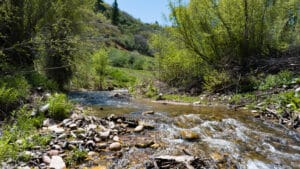
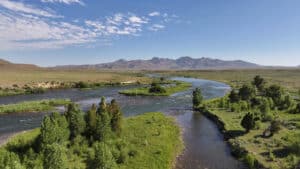
Riparian land — land along streams and rivers — has additional value beyond water rights. It provides the most productive wildlife habitat on a ranch, the most diverse plant communities, the most reliable shade and water for livestock, and recreational fishing access. A ranch for sale where a significant portion of the acreage is river or creek bottom is generally more valuable per acre than one where the water is confined to a small corner of the property.
Groundwater
Groundwater is increasingly important as surface water becomes more contested, particularly for western ranches. A ranch with reliable, high-quality aquifer access through one or more productive wells has a form of water security that surface-only operations lack. In some areas, groundwater is separately appropriated and regulated; in others, it’s more accessible. Depth to water, flow rate, and water quality all affect practical value. As surface water conflicts intensify, groundwater may become the backstop that keeps operations viable in drought years.
WILDLIFE & HUNTING VALUE
 |
 |
 |
The transformation of hunting from a casual activity into a serious commercial enterprise over the past three decades has been one of the most significant structural changes in western ranch and ranch real estate economics. What was once a courtesy extended to friends and neighbors has become a managed resource with real market value, and the ranches that recognized this earliest, including many ranches for sale today, and managed accordingly, have seen it reflected dramatically in their land values and long-term land investments.
Managed Habitat
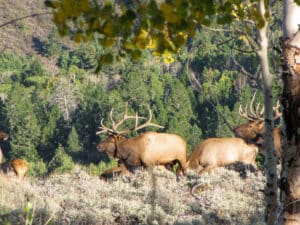
The foundation of high wildlife value on western ranches is habitat, and habitat is manageable. The key habitat components that support high wildlife populations are cover, food, water, and mineral sources, arranged across the landscape to meet wildlife needs year-round. Elk, for example, need summer range at higher elevations, winter range at lower elevations with accessible forage, transitional areas between them, and reliable water sources throughout. A ranch that provides multiple components of this seasonal cycle will hold more elk and hold them more consistently than one that provides only part of it. Deer, both mule deer and whitetail, have similar though somewhat different requirements. Understanding the specific wildlife species you’re managing and their habitat needs is the starting point for any serious wildlife management program on western ranches.
Access Control
Access control is arguably the single most impactful management action a ranch owner can take for wildlife. Uncontrolled hunting pressure — whether from trespassers, excess permitted hunters, or the owner’s own over-harvest — suppresses wildlife populations and drives animals off the property. A ranch that has been strictly controlled for access over many years will consistently carry more and higher-quality wildlife than one that has been openly hunted. Trophy quality in particular — mature bull elk, older class mule deer bucks — requires that animals be allowed to age past what they would survive on a heavily hunted property. This takes patience and active enforcement but compounds in value over time.
Predator Management
Predator management is controversial in some circles, but it is a real management tool. Conversely, some buyers specifically value intact predator populations for the wilderness character they represent, so this is a buyer-profile-dependent consideration.
Habitat Improvement
Habitat improvement programs — food plots, water developments, mineral lick maintenance, invasive species control, prescribed burning where appropriate and legal, riparian restoration — all add to carrying capacity and wildlife health over time. Some of these investments have costs that are difficult to recoup in the short term but pay off significantly over a 10–20-year management horizon. The Bureau of Land Management, Natural Resources Conservation Service, and other government agencies offer programs that can cost-share some of these improvements, reducing the out-of-pocket investment.
The capitalization of hunting value into land value follows roughly the same logic as commercial real estate — if a ranch generates $150,000 annually in net hunting lease income and buyers are willing to capitalize that income stream at a 3–4% rate, it supports $3.75–5 million in additional land value beyond the base agricultural and aesthetic value. Sophisticated ranch buyers and sellers increasingly understand this math, and properties with documented histories of hunting income are marketed and priced accordingly.
FISHERIES VALUE
 |
 |
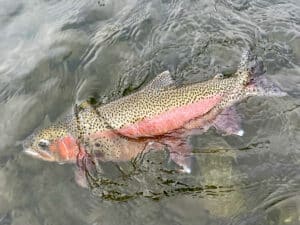 |
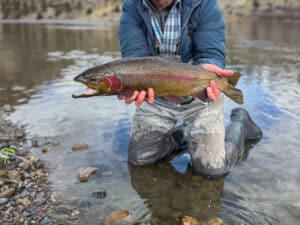
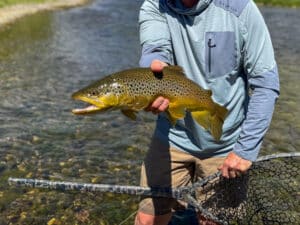
Trout fishing in Montana, for example, has cultural significance and commercial value that extend well beyond what the acreage of stream frontage would suggest. The Madison, Gallatin, Big Hole, Missouri, Beaverhead, Yellowstone, Bitterroot, Clark Fork, and Blackfoot rivers are internationally recognized fisheries that attract anglers from around the world. Owning private frontage on any of these rivers is a genuinely scarce asset.
The premium commanded by quality fishing water is disproportionate and has shown remarkable resilience through real estate cycles. Part of this is simple scarcity — there is a fixed and finite amount of productive trout water in Montana, and private ownership of a meaningful stretch is not replaceable. Part of it is the intensity of demand from a specific buyer profile — fly fishing enthusiasts with the wealth to buy ranch land, for whom river access is a primary purchasing criterion. And part of it is the income potential from guided fishing operations, which can generate significant revenue from a well-managed stretch of productive water.
When evaluating fishing value, the relevant variables are the species present and their quality, the productivity of the fishery in terms of fish per mile, the character of the water — whether it’s wade-fishable, float-fishable, or both — the length of the private frontage, whether the river is navigable public water or genuinely private, and the presence of any access or easement issues. Montana has a public access law that preserves public use of navigable rivers up to the high water mark, which means that simply owning river frontage doesn’t necessarily give you exclusive fishing rights — the public can float and fish the river even through private land on navigable reaches. Understanding navigability determinations and what rights the private landowner controls is important.
Fishing improvements — bank stabilization, riparian restoration, removal of fish passage barriers, tributary enhancement — can measurably increase fish populations and fishing quality over time. These investments are eligible for some cost-sharing programs and have the dual benefit of improving the fishery and demonstrating to future buyers that the resource has been actively stewarded rather than exploited.